“
This lesson is designed to give middle school students an introduction to Mendelian genetics, with a focus on dominant and recessive traits. The lesson is best taught after students have already covered the basics of DNA, cell anatomy and cell division, including meiosis. The objective of this lesson is that students will be able to determine the correct phenotype or genotype for a given trait based on their understanding of dominant and recessive traits. They will also be able to predict likely outcomes of mating pairs using a Punnett Square.
Recommended Age Group: middle school, grades 6-8
The DIGITAL VERSION of this Lesson includes:
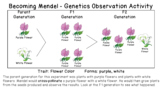
* A student activity in which students are presented with Mendel’s findings from his famous pea plant experiments and students must try to “figure out” what is going on with the traits.
*Reading passages that cover…
A review on cells and DNA
A little about Gregor Mendel and his pea plant observations
Genotypes, phenotypes, and dominant and recessive traits
Probability and how to determine offspring outcome probabilities using a Punnett Square
*A glossary of terms and a vocabulary activity
*Digital worksheet practice pages that cover…
Determining and interpreting genotypes and phenotypes
Using Punnett Squares to predict offspring probability
A culminating activity using a fictional species
*Teacher’s Answer Guide for all worksheets and teacher tips
You can preview the digital lesson here.
During the lesson students will:
*Explore and observe how traits are passed down from one generation to the next
*Make predictions about heredity
*Interpret genotype and phenotype information
*Determine the probability of a trait being passed down using a Punnett Square
Lesson Objective:
Students will be able to determine the probability of a trait being passed down to an offspring through their understanding of dominant and recessive alleles.
Next Generation Science Standards
MS-LS3-2 Develop and use a model to describe why asexual reproduction results in offspring with identical genetic information and sexual reproduction results in offspring with genetic variation.
Common Core Standards – ELA
RST.6-8.1 Cite specific textual evidence to support analysis of science and technical texts.
RST.6-8.4 Determine the meaning of symbols, key terms, and other domain-specific words and phrases as they are used in a specific scientific or technical context relevant to grades 6-8 texts and topics.
RST.6-8.7 Integrate quantitative or technical information expressed in words in a text with a version of that information expressed visually (e.g., in a flowchart, diagram, model, graph, or table).
SL.8.5 Include multimedia components and visual displays in presentations to clarify claims and finding and emphasize salient points.
Common Core Standards – Math
MP.4 Model with mathematics
6.SP.B.5 Summarize numerical data sets in relation to their context.
Want the inside track to all my latest products and ideas for the classroom? Be sure to follow me on TpT or on Pinterest and check out my website!
Did you know? Your feedback is greatly appreciated AND it earns you TpT credit towards future purchases!
“